
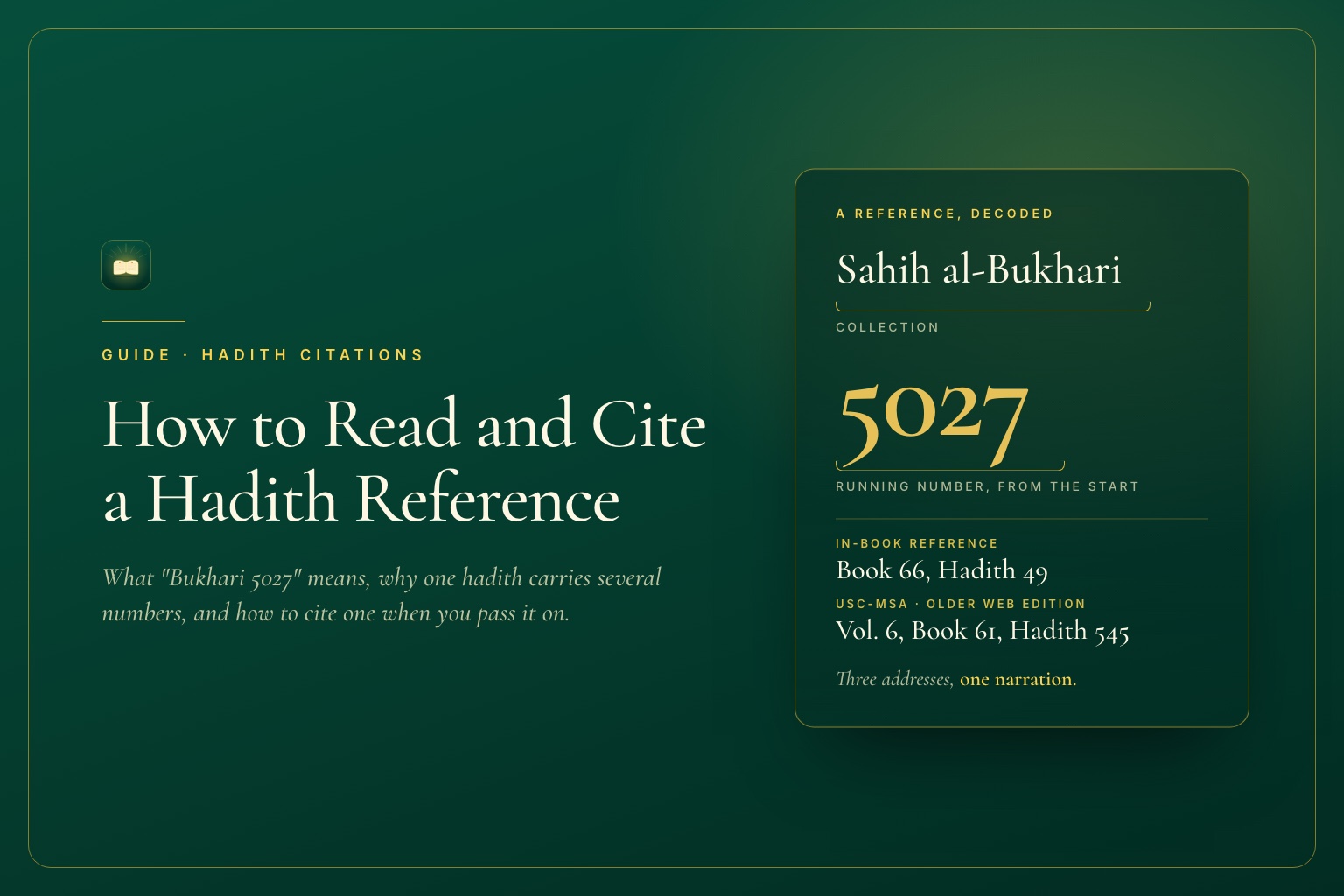
When a forwarded message ends with Bukhari 5027, it names a collection (Sahih al-Bukhari, compiled by Imam al-Bukhari) and a number that locates one narration inside it. Knowing how to cite hadith correctly starts with reading that label, because the same narration also appears as Book 66, Hadith 49 or Vol. 6, Book 61, Hadith 545, depending on the edition the sender used. None of those is wrong; they are different addresses for the same place. Below we take one reference apart, explain why the numbers differ, and show how to check a citation and write one yourself.
Anatomy of a hadith reference: Bukhari 5027, decoded
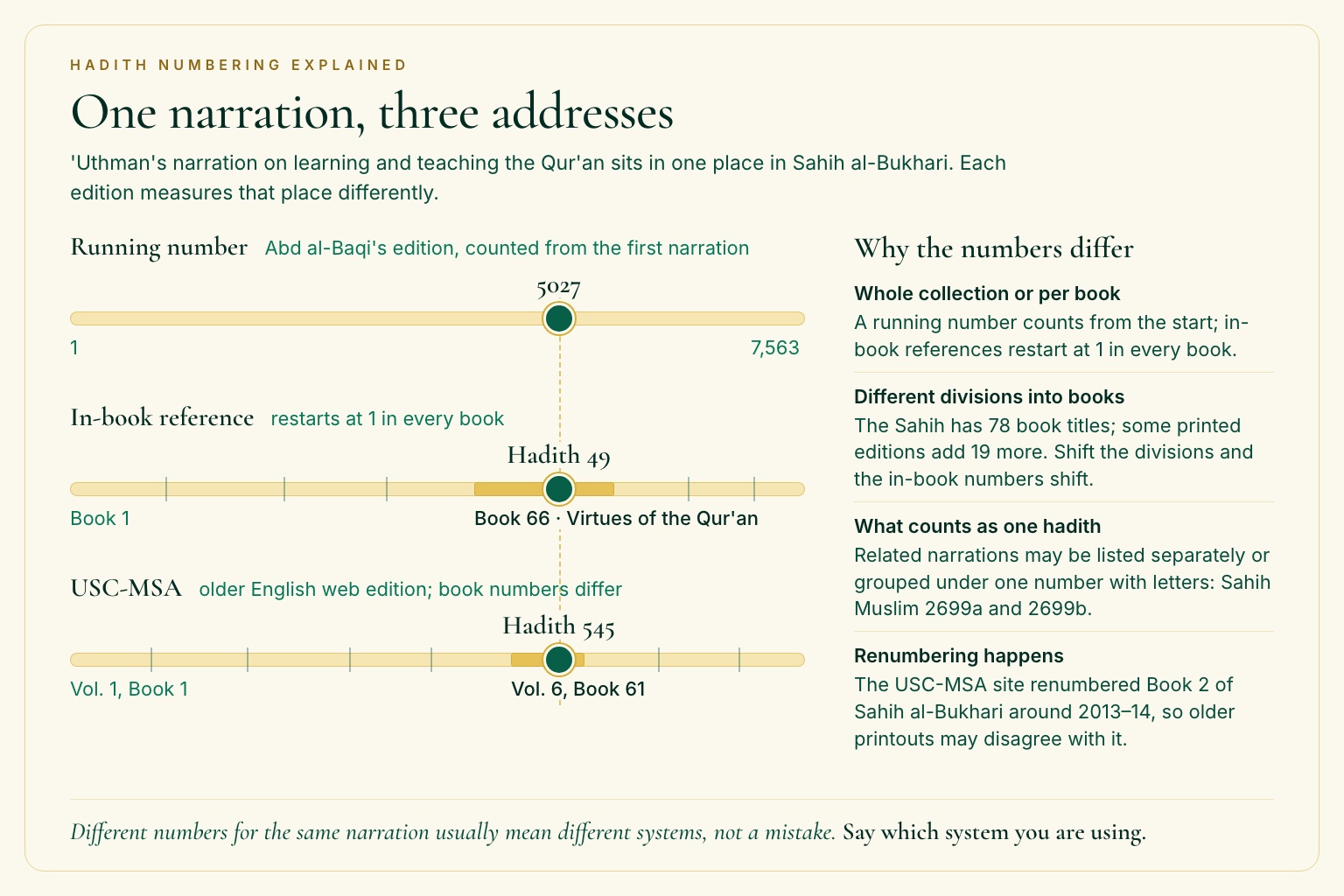
Bukhari 5027 is a narration from 'Uthman about learning and teaching the Qur'an, in the book (kitab) on the Virtues of the Qur'an. Here it is in the systems you are most likely to meet.
| Style | How it looks | What each part means |
|---|---|---|
| Collection + running number | Sahih al-Bukhari 5027 | Counts from the first narration of the whole collection, in the widely used numbering devised by Muhammad Fu'ad Abd al-Baqi. |
| In-book reference | Book 66, Hadith 49 | Book 66 is the Virtues of the Qur'an; 49 is the position inside that book. |
| USC-MSA (older English web edition) | Vol. 6, Book 61, Hadith 545 | From an older online English translation. Its book numbers differ, and 545 doesn't count from the start. |
| Letter suffix | Sahih Muslim 2699a | Related narrations grouped under one number; 2699a and 2699b are Book 48, Hadiths 48 and 49. |
Checked against sunnah.com and hadithcollection.com, September 2026; book numbers follow sunnah.com.
Hadith numbering explained: why one hadith has several numbers
The numbers in common use were assigned by later editors and translators, and they made different choices:
- Whole collection or per book. A running number like 5027 counts from the start; in-book references restart at 1 in every book.
- Different divisions into books. According to Wikipedia's summary, the Sahih has 78 book titles, and some printed editions add 19 more introduced by the editor Muhammad Fu'ad Abd al-Baqi. Change the divisions and the in-book numbers shift.
- What counts as one hadith. Related narrations may be listed separately, or grouped with letter suffixes, as in Sahih Muslim 2699a and 2699b.
- Even the total is debated. The most common count, 7,563, comes from Abd al-Baqi's edition; other scholars reach different totals.
- Renumbering happens. The QuranX project notes that the USC-MSA site renumbered Book 2 of Sahih al-Bukhari around 2013–14, so older printouts may disagree with it.
Different numbers for the same narration usually mean different systems, not a mistake. So say which system you are using.
Right text, wrong reference
A different problem runs the other way: a genuine narration arrives with a citation that doesn't lead to it, often through a copying slip. Typical patterns:
- Mixed systems. The USC-MSA number 545 written as "Bukhari 545", which points somewhere else in the collection.
- The wrong collection. A narration recorded in Sahih Muslim cited as Bukhari, or the reverse.
- Dropped or swapped digits. Easy to do when a post is retyped several times.
- A book, not a narration. "Bukhari, Book of Faith" narrows the search but locates nothing.
A wrong reference is not a verdict on the text. The words may be authentic and only the label wrong, or the reference real and the wording drifted. Either way, read what is actually there.
Checking a citation yourself
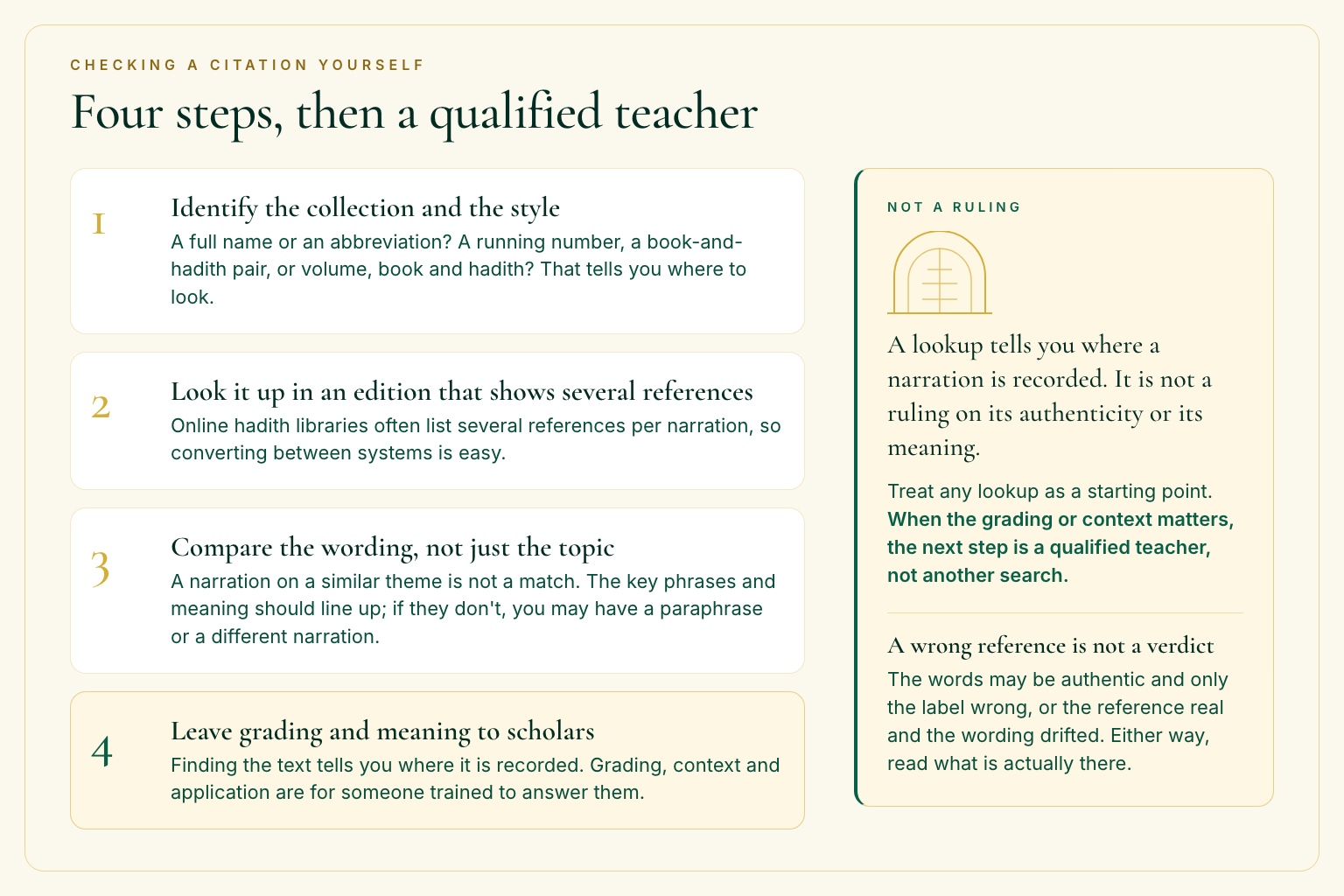
Identify the collection and the style
A full name or an abbreviation? A running number, a book-and-hadith pair, or volume, book and hadith? That tells you where to look.
Look it up in an edition that shows several references
Online hadith libraries often list several references per narration. On sunnah.com, Bukhari 5027 shows its in-book and older USC-MSA references together, which makes converting easy.
Compare the wording, not just the topic
A narration on a similar theme is not a match. The key phrases and meaning should line up; if they don't, you may have a paraphrase or a different narration.
Leave grading and meaning to scholars
Finding the text tells you where it is recorded. Grading, context and application are for someone trained to answer them.
Not a ruling
This guide explains how references work. It is not a ruling on the authenticity or meaning of any narration. Treat any lookup, ours included, as a starting point, and confirm anything you rely on with a qualified scholar.
How to cite a hadith when you share it
A good citation lets the next person check it in under a minute. Before you send, run through this:
- The full collection nameSahih al-Bukhari or Sunan an-Nasa'i, not a surname that could be misread.
- The number, and which systemSahih al-Bukhari 5027 (Book 66, Hadith 49). Two styles remove the guesswork.
- The narrator, if you know itHere, 'Uthman. It separates similar narrations.
- The translation you quotedEnglish wordings differ; name the one you used.
- A grading only with its sourceSay which scholar or edition gave it.
- Only what you have checkedIf you couldn't find it, say so, or wait.
A citation that travels well
Sahih al-Bukhari 5027 (Book 66, Hadith 49), narrated by 'Uthman, plus the translation you quoted. Anyone can find it from that line.
Where Aydeen Verify helps: citation cross-check and history
We built Aydeen Verify for the right-text, wrong-reference problem. Its citation cross-check is part of the server check arriving at launch: paste the forwarded text or send the screenshot, pick the collection and number it was cited with (or leave them blank), and Verify looks the text up in the Qur'an, the Six Books and the Muwatta. The results:
- Reference verified: the text matches the citation.
- Wrong reference: the text is found in the canonical collections, but elsewhere. An amber banner names the reference it actually matches and shows both.
- Text doesn't match the reference: the reference exists but your wording doesn't. Shown in neutral grey, never red, and not a ruling that the text is fabricated.
Every check is saved on your phone with the reference found. Wrong-reference results get their own filter and a line such as "Sent as [cited reference] — the text is [correct reference]", so weeks later you can search and forward the right citation. A share card is only offered when the text was found, never for a not-found result.
Server checks use AI (OpenAI) to read screenshots and match text. Before the first one, a dialog explains what is sent and asks for your consent. They need sign-in and come with a monthly allowance. Only the on-device Qur'an check is free, unlimited and offline; see finding which surah a verse is from. For the collections themselves, see the Kutub al-Sittah explained.
Honest limits
- Aydeen Verify isn't in the app stores yet; the server checks, including the citation cross-check, arrive with launch.
- The Number field takes a running number like 5027, not volume, book and hadith.
- Besides the Qur'an, it searches seven hadith collections: Sahih al-Bukhari, Sahih Muslim, Sunan Abu Dawood, Jami at-Tirmidhi, Sunan an-Nasa'i, Sunan Ibn Majah and Muwatta Malik. Anything else comes back as not confirmed.
- It does not grade or rule on hadith. "Could not confirm" means not found, not fake.
- AI can misread a screenshot, so you see and can edit what it read first.
Frequently asked questions
What does "Bukhari 5027" mean?
It means narration 5027 in Sahih al-Bukhari, counted from the start of the collection in the widely used numbering from Muhammad Fu'ad Abd al-Baqi's edition. By in-book reference it is Book 66, Hadith 49; in the older USC-MSA English web edition, Vol. 6, Book 61, Hadith 545.
What is the difference between an in-book reference and a hadith number?
The hadith number counts through the whole collection. The in-book reference names the book (kitab) and the narration's position inside it, restarting at 1 in each book. Both point to the same narration.
Why does the same hadith have a different number on another website?
Editions and translations divide the collections into books differently, count related narrations differently, and occasionally renumber. A different number usually means a different system, not an error.
How should I cite a hadith when I share it?
Give the full collection name, the number and its numbering style (for example, Sahih al-Bukhari 5027, Book 66, Hadith 49), the narrator if you know it, and the translation you quoted. Mention a grading only with its source, and share only what you have checked.
If a reference in a forward has puzzled you, tell us about it and we will use it to make this guide clearer. Email hello@aydeen.com — we read everything.