
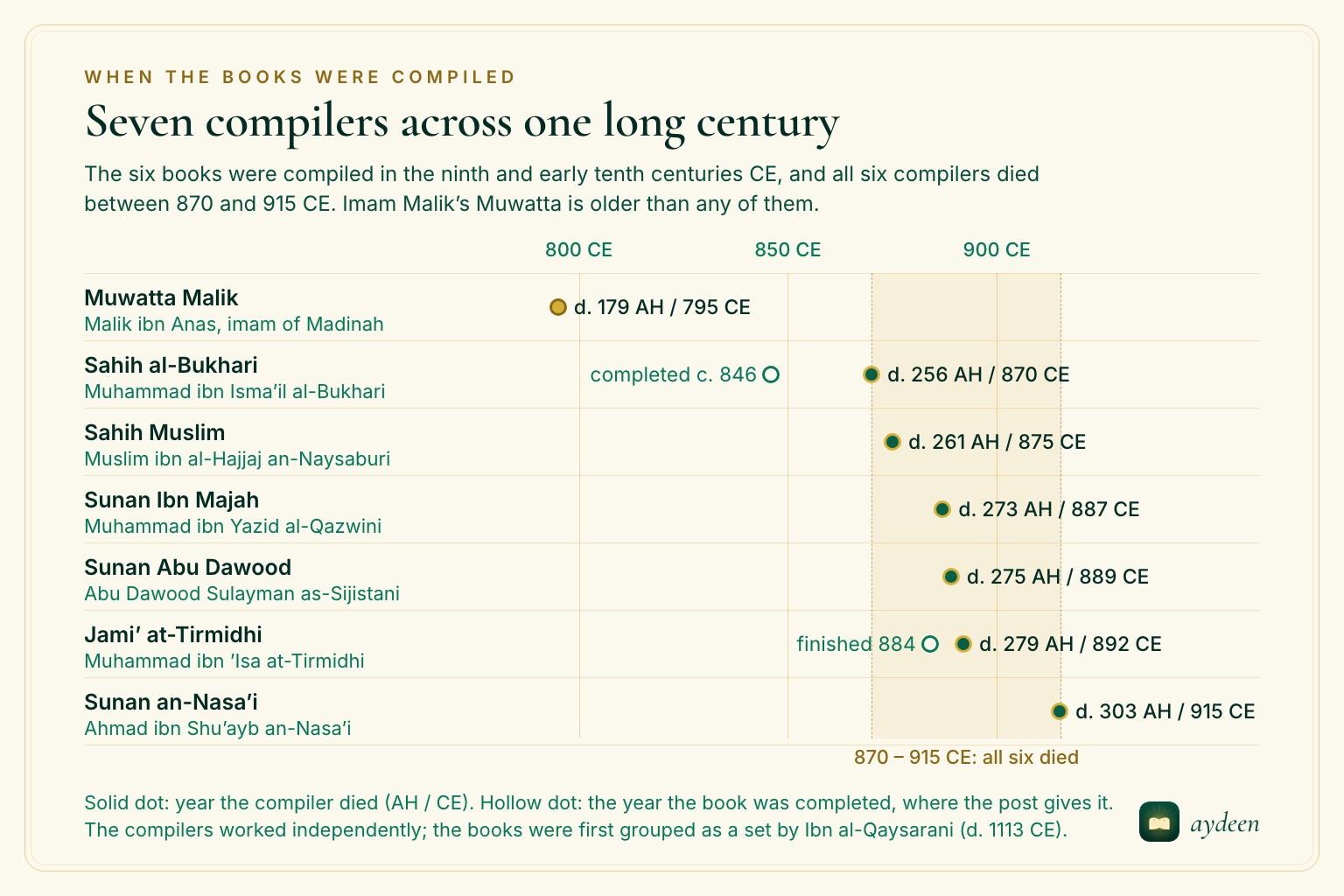
The Kutub al-Sittah (الكتب الستة, "the Six Books") are the six major hadith collections of Sunni Islam: Sahih al-Bukhari, Sahih Muslim, Sunan Abu Dawood, Jami' at-Tirmidhi, Sunan an-Nasa'i and Sunan Ibn Majah. All six compilers died between 870 and 915 CE. When a hadith is quoted with "Bukhari" or "Tirmidhi" after it, these are the books the reference points to. Here is who compiled each one, when, what sets it apart, and where Imam Malik's Muwatta fits.
What "Kutub al-Sittah" means
Kutub means books and al-sittah means "the six". You will also see al-Sihah al-Sittah, "the six authentic books", a looser name than it sounds: only two of the six set out to include nothing but sahih (sound) narrations.
The compilers worked independently and did not think of their books as a set. They were first grouped by Muhammad ibn Tahir al-Maqdisi, known as Ibn al-Qaysarani (d. 1113 CE), and his list is the one that added Ibn Majah. Not everyone agreed with that choice.
The books also differ in design. A Sahih is defined by its standard of authenticity. A Sunan is arranged by legal topic (purification, prayer, fasting, trade, marriage) so a jurist could find the narrations on a question in one place.
Not a ruling
This is a historical overview, not a fatwa and not a grading of any hadith. For the authenticity of a particular narration, and how it applies to you, confirm anything you rely on with a qualified scholar.
The two Sahihs: Sahih al-Bukhari and Sahih Muslim
Together these are called al-Sahihayn, "the two Sahihs", and most Sunni scholars rank them first and second among hadith books. That standing grew over time: Jonathan Brown's study The Canonization of al-Bukhari and Muslim (Brill, 2007) traces how they became a shared reference across the Sunni schools of law.
Sahih al-Bukhari
Muhammad ibn Isma'il al-Bukhari (194–256 AH / 810–870 CE) travelled widely to collect narrations and is thought to have completed al-Jami' al-Sahih around 232 AH / 846 CE. It is known for its chapter headings: he placed each hadith under a heading that draws out a point, and often repeated a hadith, sometimes in part, under several headings. So the count with repetitions (7,563 in the most widely used modern numbering) is nearly three times the count without (about 2,602, by Ibn Hajar's reckoning).
Sahih Muslim
Muslim ibn al-Hajjaj an-Naysaburi (d. 261 AH / 875 CE) gathered the different chains and wordings of a hadith together in one place instead of spreading them across chapters, which makes his book easy to use for comparing versions of a report. It holds roughly 7,500 narrations counting every variant; Muhammad Fu'ad 'Abd al-Baqi's widely used edition counts 3,033 without repetition.
The four Sunan
The four Sunan are practical books, arranged by legal topic. Their compilers accepted narrations below the Sahih standard, and several said so openly.
Sunan Abu Dawood
Abu Dawood Sulayman ibn al-Ash'ath as-Sijistani (d. 275 AH / 889 CE) built his Sunan around legal hadith. By the usual account he chose about 4,800 narrations from some 500,000 he had gathered; a widely used modern numbering runs to 5,274. In a letter describing his method, he said he had pointed out narrations with serious weakness.
Jami' at-Tirmidhi
Muhammad ibn 'Isa at-Tirmidhi (d. 279 AH / 892 CE), who finished his collection in 270 AH / 884 CE, is known for the remarks he adds after many hadith: his own assessment (terms such as sahih, hasan, gharib and da'if) and a note on which Companions and later jurists acted on it. That makes it a window into early legal discussion. One common numbering gives 3,956 hadith; other counts come out higher.
Sunan an-Nasa'i
Ahmad ibn Shu'ayb an-Nasa'i (d. 303 AH / 915 CE) wrote two Sunan. The one counted among the six is al-Mujtaba ("the selected"), also called al-Sunan al-Sughra, which he drew from his larger al-Sunan al-Kubra. It has 5,758 narrations including repeats. Ibn Hajar said it has the fewest weak narrations of the six after the two Sahihs, and most hadith scholars rank it next after them.
Sunan Ibn Majah
Muhammad ibn Yazid Ibn Majah al-Qazwini (d. 273 AH / 887 CE) compiled 4,341 hadith in 32 books. It contains many narrations not found in the other five, the usual reason given for its place in the set, but critics also noted more weak material. Al-Nawawi and Ibn Khaldun left it off their lists of canonical collections.
The Muwatta of Imam Malik, and why it's often included
Malik ibn Anas (d. 179 AH / 795 CE), the imam of Madinah after whom the Maliki school is named, compiled the Muwatta over some forty years. It is among the earliest surviving hadith collections, older than any of the six, and a different kind of book: in the standard recension, its roughly 1,720 reports include about 600 attributed to the Prophet ﷺ, 613 statements of Companions, 285 of the Successors, and 222 mursal reports, where a Successor quotes the Prophet ﷺ without naming the Companion in between.
It reached later generations through Malik's students, and their versions differ. Yahya ibn Yahya al-Laythi's recension is the standard one in the Maliki school; others are somewhat larger.
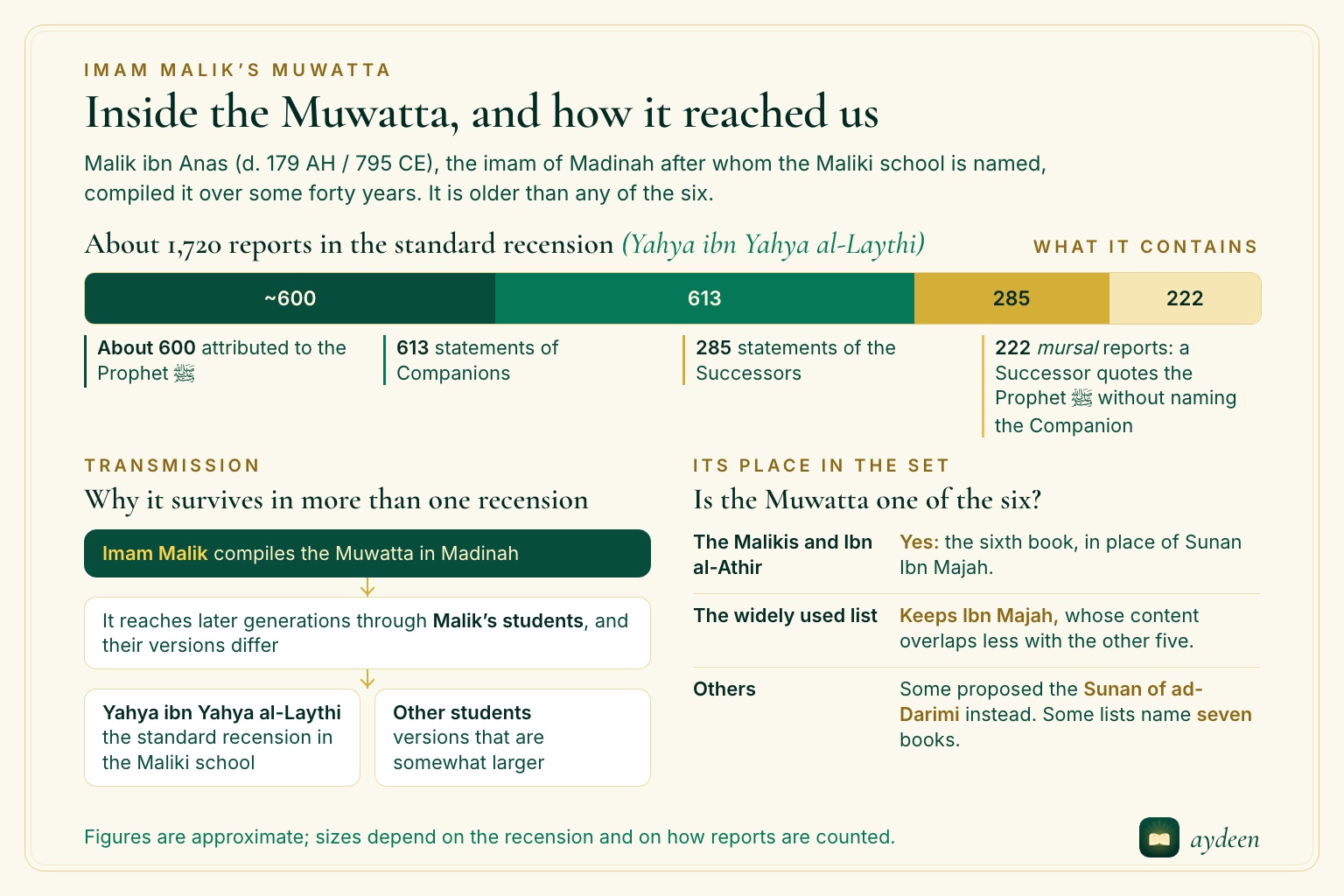
Its place in the six depends on whose list you follow. The Malikis and Ibn al-Athir count the Muwatta as the sixth book in place of Ibn Majah, and some proposed the Sunan of ad-Darimi instead. Ibn Majah largely won out because its content overlaps less with the other five. That is why some lists of the major Sunni collections name seven books.
The six major hadith books compared
| Collection | Compiler (died) | Type | Approx. size | What stands out |
|---|---|---|---|---|
| Sahih al-Bukhari | al-Bukhari (256 / 870) | Sahih | ~7,563 with repeats; ~2,600 without | Chapter headings; frequent repetition |
| Sahih Muslim | Muslim (261 / 875) | Sahih | ~7,500 with variants; 3,033 without | Variant chains kept together |
| Sunan Abu Dawood | Abu Dawood (275 / 889) | Sunan | ~4,800; 5,274 in a common numbering | Legal hadith; flags serious weakness |
| Jami' at-Tirmidhi | at-Tirmidhi (279 / 892) | Jami' / Sunan | ~3,956 in one numbering | His own grading remarks |
| Sunan an-Nasa'i | an-Nasa'i (303 / 915) | Sunan | ~5,758 with repeats | Selected from his larger Sunan |
| Sunan Ibn Majah | Ibn Majah (273 / 887) | Sunan | ~4,341 | Narrations not in the other five |
| Muwatta Malik | Malik (179 / 795) | Legal topics | ~1,720 (al-Laythi) | Earliest of the seven; sixth for some |
Dates are AH / CE. Sizes depend on the edition, the recension, and how repeats and variant chains are counted.
Why numbering differs between editions
If you have looked up "Bukhari 1234" in two places and found two different hadith, the cause is usually the edition. The numbers aren't part of the original books; later editors added them and made different choices.
- What gets counted. Repeats, variant chains and Companions' statements all change the total. The familiar 7,563 for Bukhari comes from one editor, and others argue for different totals: Khaldun al-Ahdab, for one, counts 7,208.
- Which scheme. Some editions number every narration; others number only the main hadith.
- Which recension or translation. Books like the Muwatta exist in versions of different lengths, and some translations cite by volume, book and number.
So a number alone is incomplete, not necessarily wrong. Our guide to reading a hadith reference shows how to decode one and cite a hadith so others can find it.
Good to know
If a number doesn't lead where you expect, look for the chapter name too, such as the "Book of Prayer". Chapter titles tend to hold more steadily across editions than running numbers.
Checking a forward against these books
These seven books, the six and the Muwatta, are the hadith collections Aydeen Verify searches, alongside the full Qur'an. We built it for the moment a hadith arrives in a family group chat with "Bukhari" at the bottom and you'd like to know where it really comes from before passing it on. Hadith matching is a server check that arrives with the app's launch:
Paste the text, or send a screenshot
Qur'an text is checked on your phone: free, unlimited, offline, no account (here's how). Hadith checks run on our server, need sign-in, and draw on a monthly allowance that Premium raises.
Agree to the AI step first
Before any server check, a dialog explains that the server uses OpenAI to read what you submit and match it, that only the text you typed or the image you chose is sent, that Aydeen Verify doesn't keep your image, and that OpenAI may hold the request for up to 30 days for abuse monitoring and doesn't train on it. For a screenshot, you see what was read and can correct it first.
Read the result for what it is
A match names the collection and number where the text was found. If the forward cited the wrong book or number, an amber banner shows where it actually comes from. If nothing matches, the card says Could not confirm: not found in these books, which is not a ruling that the text is fabricated.
That last point matters. Seven books are a finite corpus, and many authentic narrations are recorded elsewhere, for example in the Musnad of Imam Ahmad. So "not found" is a reason to ask someone knowledgeable, not a verdict.
Honest limits
- Aydeen Verify isn't in the app stores yet; the server hadith check is part of its launch.
- Hadith checks don't work offline. Only the Qur'an check runs entirely on your phone.
- It doesn't grade hadith, analyse chains of narration or issue rulings.
- It searches the Qur'an and these seven collections only, not Musnad Ahmad, Riyad as-Salihin or others.
- Server checks draw on a monthly allowance. Premium raises it but doesn't make it unlimited.
Frequently asked questions
What are the six books of hadith (Kutub al-Sittah)?
They are Sahih al-Bukhari, Sahih Muslim, Sunan Abu Dawood, Jami' at-Tirmidhi, Sunan an-Nasa'i (al-Mujtaba) and Sunan Ibn Majah. All six were compiled in the ninth and early tenth centuries CE. Some scholars count Imam Malik's Muwatta as the sixth book instead of Ibn Majah.
Is Sahih al-Bukhari more authentic than Sahih Muslim?
Most Sunni scholars rank Sahih al-Bukhari first and Sahih Muslim second; together they are called al-Sahihayn. That ranking concerns the books as a whole. Questions about a particular narration are for a qualified scholar.
Is the Muwatta one of the six books?
On some lists. The Malikis and Ibn al-Athir count it as the sixth book in place of Sunan Ibn Majah. The more widely used list keeps Ibn Majah, and some lists add the Muwatta as a seventh major collection.
Why does the same hadith have different numbers in different places?
Later editors added the numbers and counted differently: some include repeats and variant chains, some number only the main hadith. Give the collection, the number and the chapter name so others can find it.
Does “Could not confirm” in Aydeen Verify mean a hadith is fake?
No. It means the text wasn't found in the Qur'an, the six books or the Muwatta. Many authentic narrations are recorded in other collections. It is not a ruling; ask a qualified scholar.
Is there a collection or a question about hadith references you'd like us to cover next? Email hello@aydeen.com — we read everything.