
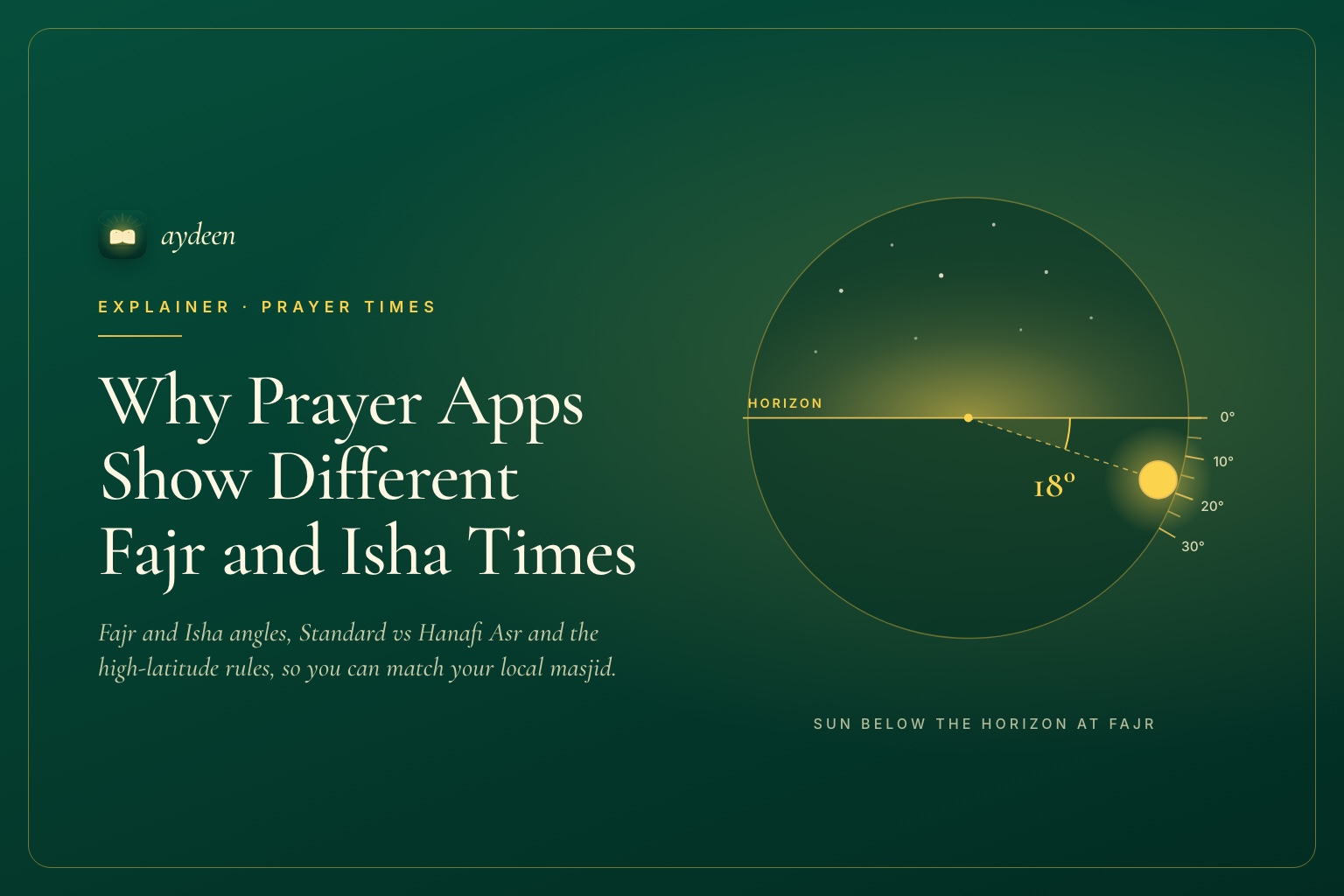
If your app says Fajr is at 4:12 and your masjid's timetable says 4:35, neither is necessarily wrong. Every prayer app turns the position of the sun into clock times using a small set of published parameters — its prayer time calculation method. Dhuhr and Maghrib hardly vary between methods, because solar noon and sunset are fixed astronomical moments. Fajr and Isha depend on how dark the sky has to be, and different bodies answer that with different angles. Asr depends on your school of fiqh. Change any of these settings and the times move.
Below: each setting in plain language, the common methods side by side, and how to set things up in Aydeen. We don't argue that one method is correct; scholars and national bodies differ.
Why two apps disagree
Each prayer is tied to the sun: Dhuhr just after solar noon, Asr when shadows reach a set length, Maghrib at sunset, Fajr at true dawn and Isha once twilight has gone. Noon and sunset are single moments. Dawn and dusk are gradual, so each method has to choose a threshold.
Disagreements usually come from:
- Twilight angles for Fajr and Isha: the biggest cause.
- Asr convention: Standard or Hanafi.
- A high-latitude rule taking over in summer.
- Location: a city centre, an old GPS fix or the wrong time zone.
- Timetable conventions: many masjids print the iqamah time, when the congregation stands, and some add precautionary minutes.
Prayer time calculation methods compared: the Fajr and Isha angles
A method mostly boils down to two angles: how many degrees the sun sits below the horizon at Fajr and at Isha. A bigger angle means a darker sky, so Fajr comes earlier and Isha later.
We ran the numbers with adhan, the open-source library Aydeen uses. In Chicago on 10 September 2026, ISNA (15°) puts Fajr at 5:07 a.m., the Muslim World League (18°) at 4:49 a.m. and the Egyptian method (19.5°) at 4:41 a.m. Isha runs the other way: 8:27 p.m. with ISNA, 8:38 p.m. with the Muslim World League and 8:44 p.m. with Karachi's 18°. The gaps vary with latitude and season.
The sun is the same for everyone. What differs is where each method draws the line.
| Method | Fajr | Isha | Notes |
|---|---|---|---|
| Muslim World League | 18° | 17° | Used internationally |
| Umm al-Qura | 18.5° | 90 min after Maghrib | Saudi Arabia. Isha is a fixed interval, not an angle; adhan's documentation notes an extra 30 minutes in Ramadan |
| Egyptian General Authority of Survey | 19.5° | 17.5° | Egypt. Early Fajr |
| University of Islamic Sciences, Karachi | 18° | 18° | Pakistan |
| ISNA (North America) | 15° | 15° | Later Fajr, earlier Isha |
| Moonsighting Committee | 18° | 18° | Adds seasonal adjustments; switches to one-seventh of the night at or above 55° latitude |
| UOIF | 12° | 12° | France |
| JAKIM | 20° | 18° | Malaysia |
| Diyanet | 18° | 17° | Turkey |
Angles as published by the adhan library and PrayTimes.org. The Moonsighting Committee and Diyanet rows come from adhan, which calls its Diyanet settings an approximation, and the JAKIM row from AlAdhan's method list. Official timetables may add their own precautionary minutes, so a body's own published timetable is always the reference.
You'll often see this debated as "Fajr angle 18 vs 15". The Fiqh Council of North America, for example, suggests 15° for both Fajr and Isha in the USA and 13° in Canada, while other bodies use 18° or more. We list these positions side by side, not in order of merit.
Asr: shadow length, Standard vs Hanafi
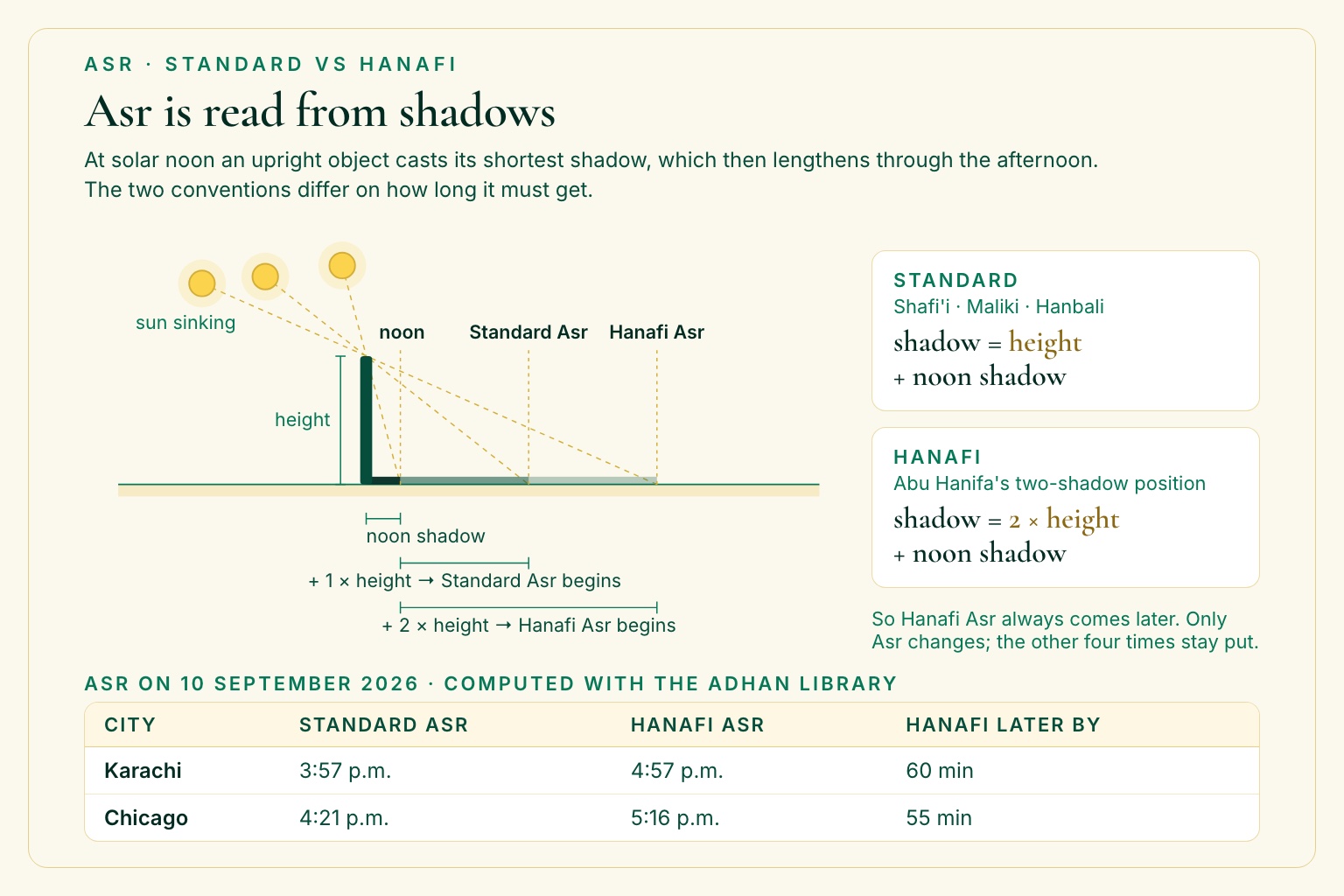
Asr is measured with shadows. At solar noon an upright object casts its shortest shadow, which then lengthens through the afternoon. The conventions differ on how long it must get:
- Standard (the Shafi'i, Maliki and Hanbali position): Asr begins when an object's shadow equals its own height, plus the length of its noon shadow.
- Hanafi: Asr begins when the shadow reaches twice the object's height, plus the noon shadow.
So Hanafi Asr always comes later. In Karachi on 10 September 2026, Standard Asr begins at 3:57 p.m. and Hanafi Asr at 4:57 p.m. In Chicago the same day it's 4:21 p.m. and 5:16 p.m. Only Asr changes; the other four times stay put.
The difference is an old one. As an answer on SeekersGuidance explains, Imam Abu Hanifa held the two-shadow position, while his students Abu Yusuf and Muhammad ibn al-Hasan held the one-shadow position.
Not a ruling
This is a general overview of how prayer times are calculated, not a fatwa. Which method or Asr time you should follow is a question for a qualified scholar or your local imam.
High-latitude summers: three common rules
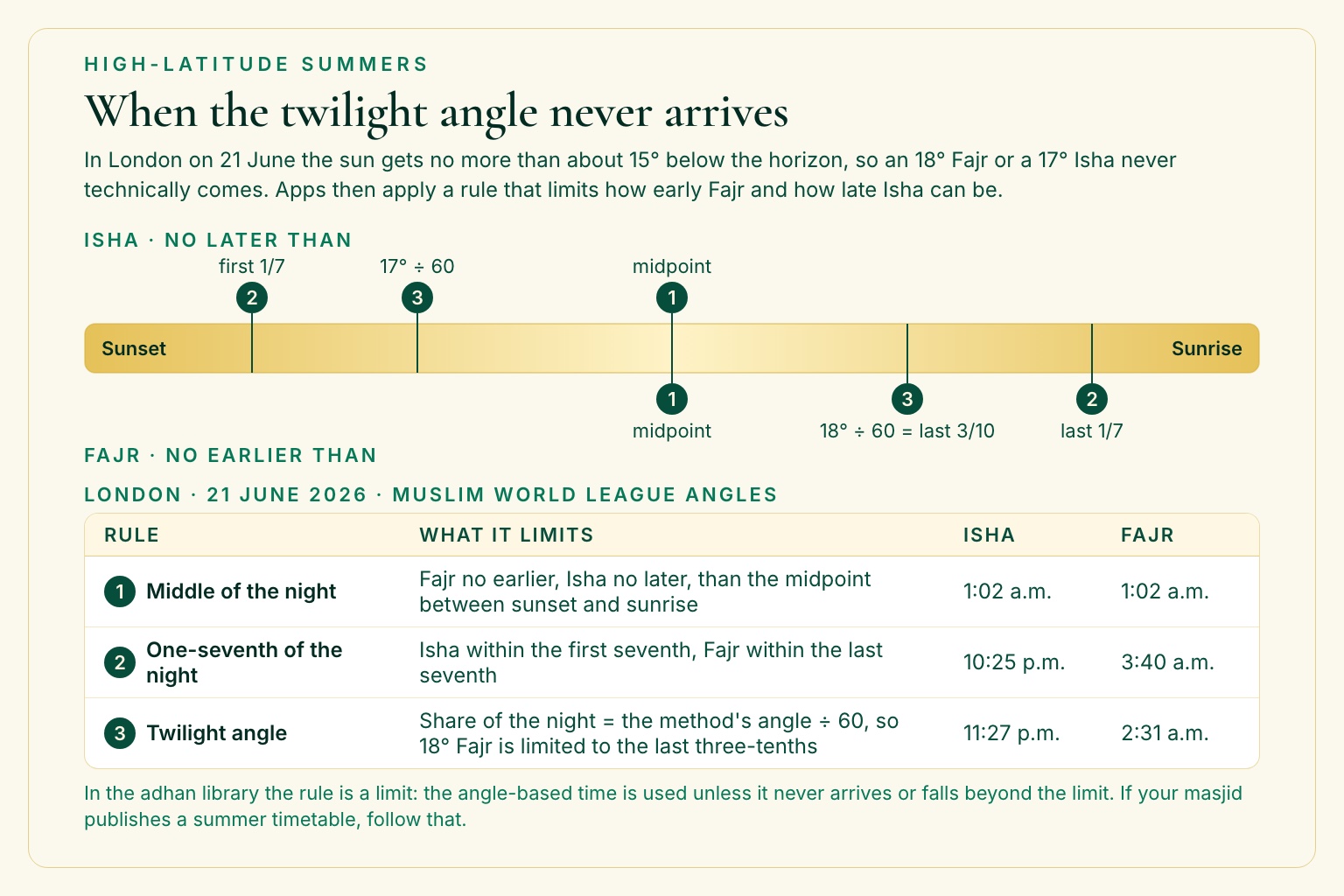
Twilight angles assume the sun sinks far enough below the horizon each night. Further from the equator, around midsummer, it doesn't. In London on 21 June the sun gets no more than about 15° below the horizon, so an 18° Fajr or a 17° Isha never technically arrives. Places further north, such as Scotland and Scandinavia, face the same problem for longer.
Apps handle this with a high-latitude rule, which limits how early Fajr and how late Isha can be:
Middle of the night
Fajr is no earlier, and Isha no later, than the midpoint between sunset and sunrise.
One-seventh of the night
The night is split into seven parts. Isha comes no later than the end of the first seventh, and Fajr no earlier than the start of the last seventh.
Twilight angle
The share of the night follows the method's angle: the angle divided by 60. An 18° Fajr is therefore limited to the last three-tenths of the night.
In the adhan library the rule is a limit: the angle-based time is used unless it never arrives or falls beyond the limit. The choice matters. For London on 21 June 2026 with the Muslim World League angles, Fajr comes out at 1:02 a.m. under Middle of the night, 2:31 a.m. under Twilight angle and 3:40 a.m. under One-seventh. Isha comes out at 1:02 a.m., 11:27 p.m. and 10:25 p.m. respectively.
If your local masjid publishes a summer timetable, follow that.
How to choose: match your local masjid
We don't rank the methods. For daily life, the practical approach is to use what your local masjid uses, so your adhan and the congregation line up.
- Find your masjid's timetableWebsite, noticeboard or printed sheet. Many name the method or the angles in the small print.
- Separate start times from iqamah timesCompare your app with the time each prayer begins, not with when the jama'ah stands.
- Pick the matching method and Asr conventionIf the timetable doesn't say, ask the imam or the masjid committee.
- Compare a few daysConsistently a few minutes out? The timetable may add precautionary minutes; a per-prayer adjustment closes the gap.
- Travelling?Set your location to where you are and look up a local masjid's timetable there.
If your trip is for Umrah, our Umrah packing list and our guide to keeping count in Tawaf and Sa'i cover the rest of the journey.
Setting it up in Aydeen
Aydeen's prayer settings follow the same approach: choose the method your masjid uses, then fine-tune. In Prayer settings you'll find:
Location
Use your current location, or type a city or address, which is handy when GPS is unavailable or when you want your hometown's times while travelling.
Calculation method
Ten are listed, including Muslim World League, Umm al-Qura, Karachi, Egyptian, ISNA and Moonsighting Committee, each with its Fajr and Isha figures underneath. If your masjid uses angles of its own, type both the Fajr and the Isha angle into the custom fields.
Asr
Standard (Shafi'i / Maliki / Hanbali) or Hanafi. Choosing Hanafi as your madhhab during setup sets this for you.
Time adjustments
Add or subtract minutes for each prayer separately, to line up with your masjid's timetable.
High-latitude rule and adhan
Choose Middle of the night, Seventh of the night or Twilight angle. For each prayer, pick one of six adhan voices (Makkah, Madinah, Mishary Rashid Alafasy, Egyptian, Turkish or a short beep), or switch that prayer's adhan off. Adhan notifications are scheduled on your phone.
Prayer times and the adhan are among Aydeen's always-free features. The free tier shows non-personalised, G-rated banner ads, which Premium removes. For the rest of the daily features, see our tour of Aydeen's daily worship features.
Honest limits
- Aydeen calculates from astronomy. It doesn't download your masjid's timetable or iqamah times, so compare the two for a few days when you first set up.
- A new install starts on the Muslim World League method rather than guessing from your country. Choose your masjid's method once and it's saved.
- Umm al-Qura's longer Ramadan Isha isn't applied automatically. If your masjid follows it, use the Isha minute adjustment during Ramadan.
Frequently asked questions
Why is Fajr in my app different from my masjid's timetable?
Usually different Fajr angles: 15° puts Fajr later than 18° or 19.5°, by 18 minutes in our Chicago example. Other causes are a printed iqamah time, precautionary minutes or a location mismatch. Match the method first, then fine-tune with a minute adjustment.
What is the difference between an 18° and a 15° Fajr angle?
The angle is how far the sun sits below the horizon. At 18° the sky is darker than at 15°, so an 18° Fajr comes earlier and an 18° Isha comes later. In Chicago on 10 September 2026, Fajr was at 4:49 a.m. at 18° and 5:07 a.m. at 15°. The size of the gap changes with latitude and season.
Why is Hanafi Asr later than Standard Asr?
Standard Asr (the Shafi'i, Maliki and Hanbali position) begins when an object's shadow equals its height plus its noon shadow. Hanafi Asr begins when the shadow reaches twice the object's height plus the noon shadow, which takes longer: about an hour longer in our Karachi and Chicago examples.
Which prayer time calculation method is the correct one?
We don't rank them. The methods reflect positions held by different scholarly bodies and national authorities. For daily prayer, most people follow their local masjid's timetable, and anyone unsure which method or Asr time to follow should ask a qualified scholar.
Is there a method or a local timetable Aydeen doesn't match yet? Email hello@aydeen.com — we read everything.